Agentic AI has created new possibilities for transforming how companies operate. The potential to enhance workflows, adapt to changing conditions, and amplify business outcomes has never been greater. However, reaching that potential starts with something often overlooked: a clear and detailed understanding of how work actually happens.
At DAIN Studios, we have developed a structured approach to help organizations move beyond theoretical conversations about AI. Our Agentic AI Opportunity Workshop is designed to align teams, clarify processes, and guide the development of agentic solutions that are ready for real-world deployment. Success begins not with writing code or selecting technologies, but with mapping the work that drives value every day.
Without a precise view of operations, organizations risk applying AI to the wrong problems, introducing complexity without improving outcomes. Agentic AI systems depend on structured environments to operate effectively, and structure depends on clarity.

A Practical Foundation: Why Process Mapping Matters
Enterprise workflows are often more complex than they first appear. What looks like a single process from a distance usually consists of multiple sub-processes, dozens of tasks, and many points of decision-making and handoffs. Inputs may vary, data quality may shift, and human judgment may still be needed at critical stages.
Mapping these workflows is essential because it reveals which parts are stable, rule-driven, and ready for automation, and which require flexible reasoning that is better suited for AI agents. It also identifies where human involvement remains vital. Every task has its own level of automation readiness, and understanding this landscape is critical to avoid wasting effort or misaligning solutions.
In the workshop, teams work through their workflows carefully, uncovering hidden complexity, noting areas where inputs are unstable, and tagging tasks based on decision complexity and data variability. This creates a clear view of where RPA (Robotic Process Automation), AI agents, and human expertise each have the strongest role to play. With that clarity, organizations can design agentic systems that are properly matched to their environment rather than forcing technology into unsuitable contexts.
Moving Toward Implementation: From Mapping to Design
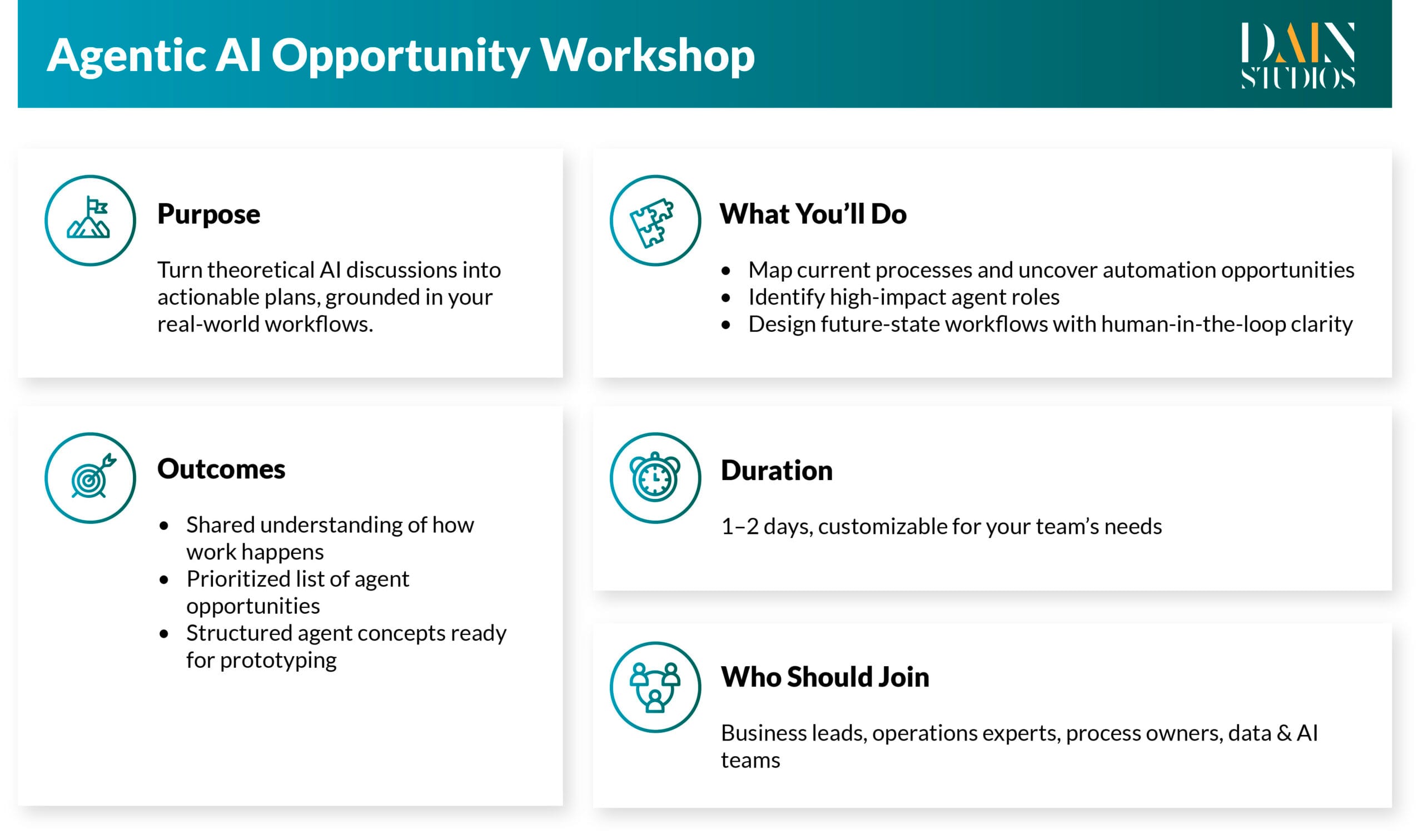
The workshop structure is built around three connected exercises: Agent Discovery, Agent Refinement, and Agent Mock-Up.
In the discovery phase, participants map their current workflows in detail. Rather than focusing only on responsibilities or organizational charts, they explore how work actually flows across systems, people, and handoffs. This creates a shared understanding that becomes the basis for identifying opportunities.
During the refinement phase, teams ideate around AI capabilities using structured cards that stimulate focused thinking. They identify potential agent roles based on the realities uncovered during mapping, not based on abstract or generic ideas. Impact and feasibility are considered early, helping teams prioritize ideas that have a clear path forward.
Finally, the mock-up phase allows participants to describe agent concepts in a structured way: defining roles, required tasks, system contexts, and levels of human interaction. By drafting a future-state workflow that clearly separates human tasks from agent tasks, teams can visualize how agents would operate within their processes, where human-in-the-loop controls are needed, and how value flows through the new design.
This progression moves participants steadily from exploration to design, keeping one foot in operational reality at every step.

Designing with Human-in-the-Loop in Mind
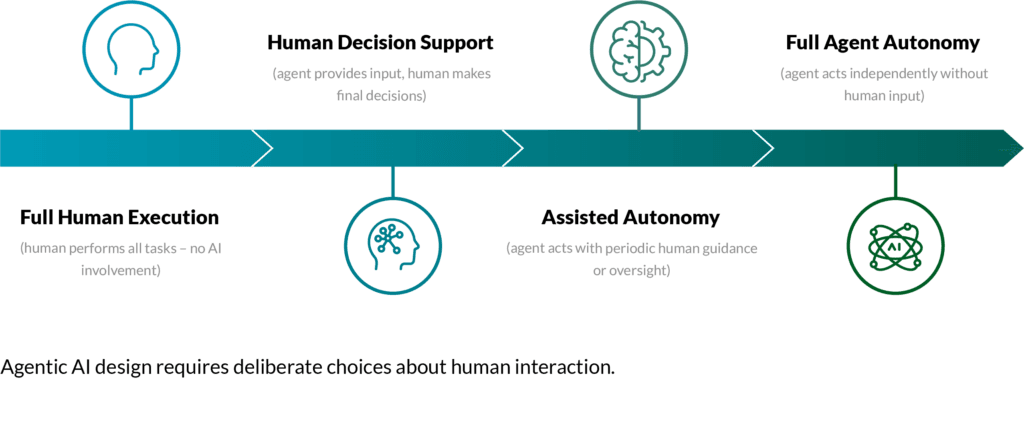
In real enterprise environments, autonomy is rarely absolute. While agents can handle many tasks independently, there are always points where human judgment, oversight, or escalation is necessary. Designing for human-in-the-loop from the beginning ensures that systems are not only functional but also trusted and sustainable.
The workshop explicitly integrates this thinking into the design process. Participants assess where agents should operate independently, where they should assist humans, and where final decisions must stay with people. This level of clarity leads to smoother deployments, better adoption, and systems that evolve naturally as trust in agentic automation grows.
Building Agentic AI Systems That Deliver
Agentic AI initiatives achieve their promise when they are grounded in the real way organizations create value. Designing effective agents starts with mapping the work, understanding the structure of processes, and building systems that reflect how decisions are made and tasks are completed.
Our workshop approach helps organizations move beyond high-level discussions into actionable outcomes. Teams leave the session with a prioritized list of agent opportunities, structured agent concepts, and a clear understanding of the workflows they will impact. This makes the transition from ideas to pilots, and from pilots to scaled solutions, much faster and much more reliable.
Organizations that invest now in aligning their processes with agentic design principles will be best positioned to capture the transformative gains AI can offer in the years ahead.
Ready to Take the Next Step?
If you are preparing your business for the future of AI-enabled operations, starting with clarity about your workflows and agentic opportunities is essential. Our structured workshop helps you build that foundation and move forward with confidence.
Interested in running this workshop in your organization?
Let’s talk!