Most organisations running AI today have a growing list of use cases, a set of pilots scattered across the business, and a gap between what those pilots are producing and what is actually changing in how the organisation works.
In most cases, the problem sits in the workflow.
The use case list that goes nowhere
Across our work, and in the Harvard Agentic AI Intensive where we teach alongside Harvard Data Science Initiative faculty, we see the same pattern across industries and organisation sizes. AI ideas accumulate faster than organisations can act on them. Some teams have hundreds of use cases catalogued in spreadsheets and have not yet decided which three deserve full focus.
This creates a recurring cycle of ideation, pilot, and pause, where AI is discussed constantly but rarely changes how anyone works. At some point, leadership has to choose which workflows matter and what it means to redesign them. That choice requires a fact-based picture of how those workflows actually run today, which most teams find harder to produce than expected.
The question that changes the room
In the Harvard Agentic AI Intensive, we see what happens when that shift occurs. Participants arrive asking broad questions: which AI platform to choose, which vendor has the best features, how to deploy agents in customer service. Within a week of working through a real workflow from their own organisation, the questions change.
Leaders are asking which specific decisions should stay with humans, what level of autonomy is acceptable, and what data and governance need to be in place before anything goes into production. A broad AI opportunity conversation can run for months without producing anything executable. A workflow-level conversation tends to surface the real constraints and choices within hours.
More than 1,000 senior leaders have come through the Harvard programme. The pattern holds across industries, geographies, and organisation sizes.
What workflow redesign actually requires
Automation runs an existing process faster. Redesign asks what the process should look like if built today, with AI as a primary actor. That requires a different starting point: a shared understanding of how the workflow actually works, including the tasks, handoffs, decision points, and where work slows down or fails.
From that shared understanding, the productive questions follow. What does the business actually need to gain? Where should AI act and where should humans stay in control? How are exceptions and escalations handled? How will you know if the redesign worked?
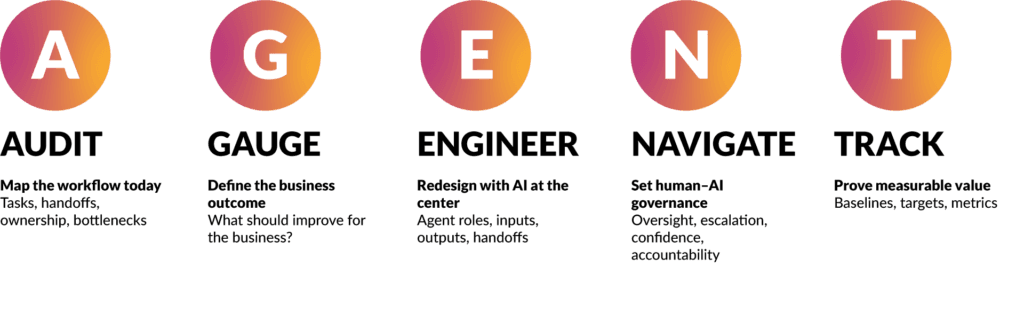
The A.G.E.N.T. Framework is built around these questions: Audit, Gauge, Engineer, Navigate, Track. Five steps from a fact-based picture of the current workflow through to a redesigned version with defined roles, governance, and measurement. The framework is taught in the Harvard programme and applied in client work across Europe and the United States.
Governance belongs in the design
One consistent finding from the Harvard cohorts: governance is harder to define after a workflow has been redesigned than during the process. Handovers, escalation paths, and accountability rules are much easier to work through while the design is still being shaped.
The Navigate step in A.G.E.N.T. covers this directly: who decides what, where humans remain in the loop, what happens when AI is uncertain, and how autonomy can increase as trust is established. AI governance tends to fail in one of two directions. Either every AI output requires human approval, adding a step rather than removing one. Or AI runs with no oversight and no clear escalation path. Deciding which specific decisions genuinely need a human, and which do not, has to happen before a workflow goes into production.
The first step
The organisations that move from pilots to changed operations tend to start simply: one workflow, one team, one structured session to map what actually needs to change.
From that starting point, the scope becomes clear: what needs to be built, what governance is required, what the business stands to gain. If your organisation has the pilots and the ambition but the workflows are not changing, the question worth asking is which workflow to redesign first.
DAIN Studios works with organisations in DACH and Finland on workflow redesign for the agentic era, through workshops, trainings, and strategy engagements. Reach out to discuss what a first session might look like for your team.
More on the A.G.E.N.T. Framework: dainstudios.com/services/agent-framework/