A.G.E.N.T. Framework: Redesign Workflows for the Agentic Era
Turn a real workflow into a more agentic way of working.
Most organizations do not need more AI ideas. They need a practical way to redesign work so AI agents can take on meaningful responsibility while humans stay in control of what matters.
The A.G.E.N.T. Framework is our structured method for doing exactly that. It helps teams understand how a workflow works today, define the business outcome that matters, redesign the workflow with AI as a primary actor, and build the governance and measurement needed to make it work in practice. This is how you move from isolated experiments to workflows that are faster, clearer, and more effective by design.
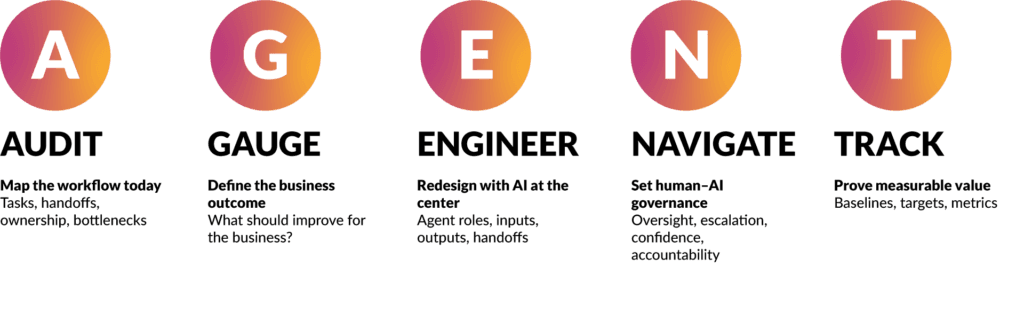
A.G.E.N.T. Framework
Working with the A.G.E.N.T. Framework
The A.G.E.N.T. Framework is designed for one important job: taking a chosen workflow and redesigning it so humans and AI agents can work together in a practical, accountable, and outcome-driven way.
Each step builds on the previous one. First, you create a shared understanding of how the workflow actually runs today. Then you define what success should look like for the business. From there, you redesign the workflow with AI at the center, define how human oversight works, and measure whether the new model delivers real value.
Audit
Map the workflow as it works today.
We start by understanding the current workflow in detail: the tasks, handoffs, decision points, ownership, bottlenecks, and failure points. The goal is to replace assumptions with a fact-based picture of how the work really happens today.
Gauge
Define business outcomes, not just AI outputs.
This step shifts the conversation from what the AI produces to what the business gains. We define the outcomes that matter, apply the “So what?” test, and break the workflow into jobs to be done so the most valuable opportunities for agentic support become clear.
Engineer
Redesign with AI as the primary actor.
Now we redesign the workflow from a blank page. If this workflow were built today with AI agents playing a central role, what would it look like? We define explicit agent roles, inputs, outputs, and handoffs, while keeping human involvement where judgment, accountability, or exception handling is still essential.
Navigate
Design human-AI collaboration.
Agentic workflows only work when the rules are clear. We define who decides what, where humans stay in the loop, what happens when AI is uncertain or wrong, and how autonomy can increase over time. This creates a governance model that is practical enough for real operations.
Track
Prove the outcomes were achieved.
A redesigned workflow is only useful if it creates measurable business value. We define the metrics, baselines, targets, timeframes, and ownership needed to show whether the new workflow is actually delivering better results, not just generating more activity.
What the A.G.E.N.T. Framework helps you achieve
By working through one A.G.E.N.T. cycle, you get more than a prototype or a concept. You get a clearer operating model for how a workflow can function in the agentic era.
That includes:
- A documented view of how the workflow works today
- Clear business outcomes tied to the redesign
- A redesigned workflow with defined agent and human roles
- Explicit rules for oversight, escalation, and accountability
- A measurement framework that proves whether the redesign works
The result is not just an AI experiment. It is a more grounded, more executable way of working.
From workflow redesign to broader transformation
A.G.E.N.T. is not primarily a general ideation framework. It is a practical method for redesigning a real workflow and making that redesign operational.
That said, the learnings are valuable beyond the workflow itself. Once you have redesigned one workflow properly, you gain a much more realistic understanding of where agents create value, what governance is required, what kind of data and context the workflow depends on, and what it takes to scale with confidence.
That makes A.G.E.N.T. a strong starting point for broader agentic AI adoption — not because it stays abstract, but because it starts with real work.
Learn Agentic AI with Harvard and DAIN Studios
Together with the Harvard Data Science Initiative and Next Gen Learning, DAIN Studios co-designs and teaches the Agentic AI Intensive, a 2.5 week online program for executives and business leaders. The course focuses on moving from AI pilots to agent-first workflows using our A.G.E.N.T. Framework, real industry cases and an AI tutor that adapts to each participant. If you want to deepen your own capabilities, you can apply to join one of the upcoming cohorts.