Transforming into a data-driven and AI-first company demands a robust level of data and AI literacy across all organizational levels, starting with leadership. Simultaneously, companies need specialized talent in data and AI to execute analytics business opportunities. This includes roles such as data and AI strategists, data scientists, data engineers, ML engineers, and data architects, among others. A common question we often receive is how to internally organize the expert teams. This article aims to provide insights and best practices on this topic.
A crucial initial step is understanding that delivering analytics use cases and integrating them into end-to-end business processes (involving people, technology, processes) cannot be achieved by a single “unicorn” person. Whether the goal is to personalize marketing messages or optimize logistics processes, successful execution requires collaboration among people with diverse skill sets. Generally, the roles required for analytics use case delivery can be divided into four categories:
- Business roles
- Analytics (AI, ML, BI) roles
- Data Management and Governance roles
- Technical Infrastructure roles
Each role brings its unique skills and responsibilities and plays an essential part in the successful delivery and deployment of data and AI use cases.
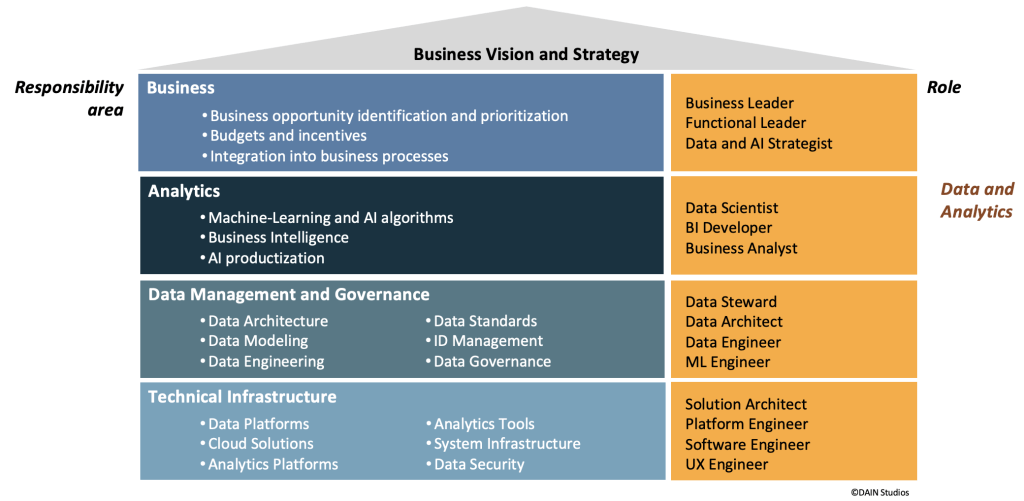
Figure 1. Analytics use case delivery requires collaboration between roles.
Although no single person can handle every aspect, it is possible for one senior individual to assume multiple roles. For instance, a data architect may also act as a data engineer, or a data scientist as an ML engineer. At its core, a minimal use case delivery team should include a platform engineer (for the technical data platform), data engineer (handling data integrations), BI developer (creating dashboards) and/or data scientist (working on machine learning), alongside the business owner who defines business needs.
As a company grows, strategically organizing the analytics workforce becomes increasingly vital to support the company’s AI-first transformation goals without encountering unnecessary organizational frictions. Given that data, analytics, and AI function as a support role, the ideal data and AI organization structure should align with the company’s overall operations.
A key consideration is the extent to which data and AI should be centralized or decentralized across the business units (BUs). On one end of the spectrum, we could have a fully centralized Center of Excellence (CoE), where all data and analytics talent is concentrated, serving the needs of all business units (Figure 2a). On the opposite end, each business unit/function could manage everything from data platforms to algorithms independently (Figure 2b). In this article, we also explore the intermediate options and the key factors a company should consider when deciding which functions to centralize and which not.
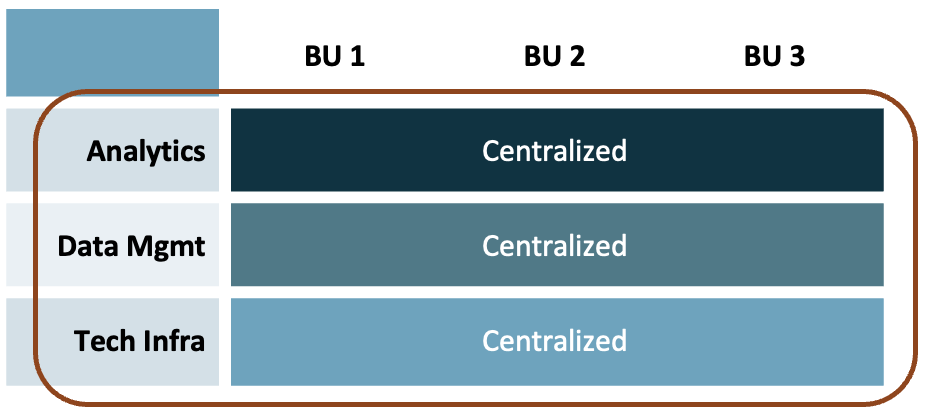
Figure 2a. Fully centralized: The same analytics, data management, and technology teams serve all business units as part of a common Center of Excellence.
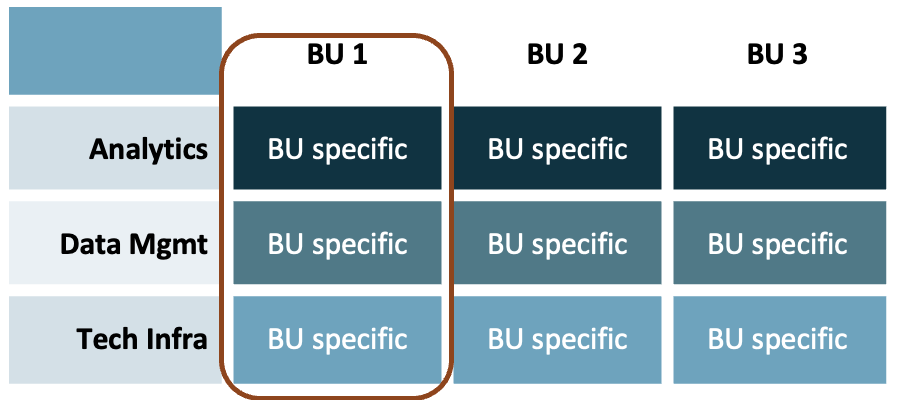
Figure 2b. Fully decentralized: Each business unit has their own separate teams for analytics, data management, and technology.
Generally, we advise consolidating the management of technical infrastructure under a single unit. While having a modern infrastructure can set a company apart, maintaining several infrastructures does not enhance a company’s competitive edge. There is little to gain from developing and maintaining many different cloud infrastructures, data platforms, analytics platforms, and analytics tools. Centralizing these elements can streamline operations, reduce costs, and ensure that all parts of the organization benefit from the most advanced and efficient technologies available.
The decision to centralize vs. decentralize the analytics/AI and data management functions requires careful consideration and depends on various factors. Table 1 outlines some key advantages and disadvantages associated with each organizational model.
| Centralized | Decentralized | |
| Pros | Efficient use of resources (people, money) Replicability: Technology, data and algorithms can be used across the organization Standardization of data models and definitions: higher data quality and cross-usability | More direct alignment with business objectives Increased agility and responsiveness because of the direct connection between business stakeholders and analytics experts Less dependency to other units about the use of resources and more control |
| Cons | Increased bureaucracy: More coordination and prioritization between the business units to allocate the resources of the central team Lack of domain knowledge: The central team may lack the critical business knowledge of the different domains | Duplication of efforts and reinvention of the wheel across the company Inconsistent data definitions, models, and standards prevent the cross utilization of data (resulting in data silos) Uneven delivery of analytics across the business units lacking common roadmaps and vision |
When evaluating the most suitable data and analytics/AI organizational model for your business, it is crucial to carefully consider the following questions:
- What is your company’s size and organizational structure?
- If your company is large and encompasses many distinct business units, each with its own products, services, and business models, a centralized analytics function may not be the best fit. The benefits of collaboration could be limited, and achieving alignment among the units could be time-consuming.
- Are your products, services, and business models consistent across markets?
- If your products, services, and/or business models are consistent across markets, there are clear benefits to fostering collaboration – even if your company is big and operates on many markets. Establishing an Analytics CoE can be highly effective if the same analytics solutions can be scaled across the organization.
- How mature are your organization’s data, analytics and AI capabilities?
- Consider whether your organization is just beginning its journey with analytics and AI, or if it already has substantial experience in integrating data and AI into decision-making processes. Do you understand what AI implies for your industry and business? Are you capable of delivering end-to-end use cases?
Based on our experience, initiating with a centralized setup for analytics/AI and data management often makes sense when embarking on the journey towards becoming a data and AI-driven organization. Setting up an Analytics/AI Center of Excellence (CoE) will help you focus your efforts and serve as a catalyst for development. This framework addresses the most challenging AI use cases and develops a scalable AI portfolio for the entire organization. In addition to the CoE, a decentralized setup might be in place, allowing business units to hire their own business analysts and, if necessary, data scientists to address specific domain-related insight requirements.
The data and AI strategists should optimally sit within the business units to drive the AI use cases forward, but early on, they may also be part of the Analytics/AI CoE, offering support from there.
The centralized technical infrastructure team might be part of the Analytics/AI CoE or fall under the IT department.
As the organization evolves into a mature data and AI organization, the Analytics/AI CoE’s role narrows. At a mature stage, the CoE will continue taking care of overarching data governance topics such as data quality and integrity, along with common ontologies and standards, and the technical infrastructure (if it’s part of the CoE). Meanwhile, analytics teams in individual business units specialize in areas directly related to their specific business needs and a central analytics/AI team may not be necessary (Figure 2c).

Figure 2c. Mature AI company: Technology is centralized, data management is partially centralized and partially BU specific, and analytics is BU specific.
A frequently posed question concerns the organizational placement of the Analytics/AI Center of Excellence. Although it might seem logical to position the CoE under the Chief Information Officer of Chief Technology Officer, we advise against it. The primary mission of an Analytics/AI CoE is to drive significant business transformation. If situated within the IT department, the CoE may be perceived merely as an IT function, which could lead to challenges in securing budgets that are often allocated to operational IT tasks. Instead, we recommend positioning the Chief Analytics/AI Officer (CAO) at the same executive level as other key roles such as CIO/CTO, Chief Digital Officer, and Chief Marketing Officer. For the CAO to effectively contribute to the organization’s data-driven and AI-first transformation, it is essential for them to have a seat at the executive table alongside their peers.