Dirk Hofmann | CEO Germany & Co-Founder, DAIN Studios
When does an AI project move from “useful” to “strategic”?
In our experience, it’s the moment a company stops asking “how do we save time?” and starts asking “how do we change what’s possible?”
Efficiency gains are a fine place to start. But they have a natural ceiling. The leaders we work with know this—they capture the quick wins, then push toward innovation: new offerings, new customer experiences, new ways of competing.
That’s where the lasting value comes from. And that’s where AI in 2026 is heading.
From saving time to changing outcomes
Here’s a pattern I keep seeing.
A company asks: “Can AI help us process documents faster?” We ask back: “What happens after you process those documents?” Turns out the real problem is decision quality, not processing speed. The documents are just an input.
Once you shift from “save hours” to “improve outcomes,” AI opens up completely different options. You can evaluate more scenarios than any human team could. Test more pricing combinations. Monitor more signals in parallel. Catch risks earlier.
That’s not incremental. That’s strategic.
“Efficiency is a necessary first step, but not the end goal. The true objective is differentiation—because efficiency gains always reach a natural end point.”
The projects that create lasting value almost never stop at the efficiency goal they started with. They evolve toward business outcomes nobody thought AI could touch.
Data becomes a product
Behind every AI initiative is a simple question: what data do we actually have, and how valuable is it?
Open data and freely available content only take you so far. Almost every sector is hitting the same wall now. The best results require high-quality, curated, often proprietary data.
In 2026, I expect more companies to treat data as a product and a revenue driver—not just exhaust from existing systems. This means understanding which datasets are truly unique, investing in their quality, and thinking about how they’re used both internally and externally.
Data monetisation won’t be an exotic topic anymore. It will be a normal strategic discussion. The question won’t be whether data can be monetised. It will be how to do it in a way that respects regulation, privacy, and brand trust.
The real bottleneck is behaviour
In most organisations, the AI bottleneck is not tools or models. It’s human behaviour.
“The biggest risk in AI transformation is behavioural: people’s natural default is to revert to old patterns, which makes episodic upskilling programmes fragile.”
We’ve run large-scale upskilling programmes for enterprises. The pattern is consistent: after a short burst of enthusiasm, many teams drift back to old routines. One-time trainings don’t change habits. Slideware doesn’t change workflows.
The organisations that make real progress rarely rely on classroom sessions alone. They combine foundational training with office hours, coaching, internal communities, and concrete follow-up tasks—so people try AI on their own work. AI literacy becomes part of the operating model, not a yearly initiative.
For AI to create value in 2026, companies need a persistent approach to skills. That means embedding AI into everyday work, connecting training to real tasks, and accepting that habits take time to change.
Smaller companies have an advantage
Smaller and mid-sized companies often feel late to AI. Budgets are tighter. The technology looks intimidating compared to what large players are doing.
But here’s the thing: complexity is lower and decision cycles are shorter. That’s a genuine advantage.
“Size is no longer an excuse. Smaller companies can use their agility and speed to turn AI into a real advantage.”
Implementation costs have come down significantly. Many capabilities are now available through platforms and services rather than heavy custom builds. For a smaller organisation, this means AI can be aimed precisely at a handful of critical processes and deployed quickly—without navigating internal bureaucracy.
The question is less about matching the scale of large competitors and more about using focus and speed to get value earlier.
Every organisation needs a forerunner
Inside every organisation, there’s usually one person—or a small group—who keeps pushing the AI agenda. Sometimes it’s a formal role. Often it’s informal. Either way, the presence of a committed forerunner is one of the strongest predictors of real progress.
The forerunner doesn’t need the deepest technical skills. What matters more is energy, curiosity, and persistence. This person keeps asking how AI should be used in critical workflows, challenges old ways of measuring value, and connects business stakeholders with data and technology teams.
In 2026, leadership teams need to recognise and support this role more clearly. Give them a mandate. Clarify decision rights. Make sure they have access to the right people and budgets. Without someone owning the push, AI stays scattered across isolated pilots.
The shift that matters
If I had to summarise where AI value will come from in 2026, it’s this:
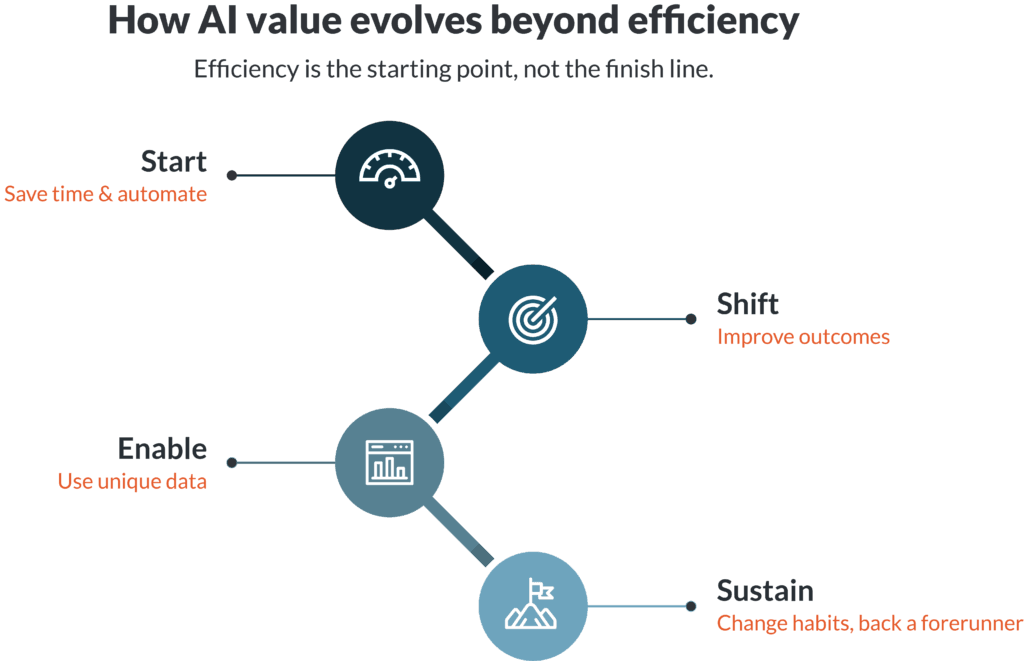
Start with efficiency—it’s tangible and builds momentum. But don’t stop there. Ask how AI can change what success looks like.
Treat your best data as a product, not a byproduct. Build AI skills into how teams work, not into annual training calendars. And find your forerunner—or become one.
Technology will keep moving fast. The organisations that move their culture with it will turn AI into something durable—not just another efficiency play that hits its ceiling in year two.
What’s the biggest gap you see between how companies talk about AI and how they actually use it?
AI in 2026 series by DAIN Studios
This article is part of our AI in 2026 series, where we look at how leading organizations will actually work with AI next year from different angles. Explore the other perspectives:
• What Matters in AI 2026: How Leading Organizations Will Actually Work With AI
• AI as a Strategic Capability in 2026
• AI in 2026: Why Efficiency Is Just the Starting Point
• AI in 2026: Governance as a Competitive Edge
• AI in 2026: Architectures for a World of Agents