In today’s data-driven world, the ability to extract actionable insights from large amounts of data has become a crucial asset for businesses. According to Fortune Business Insights, the global big data analytics market is valued at $348.21 billion, with 3 in 5 organizations using data analytics to drive business innovation and gain a competitive advantage.
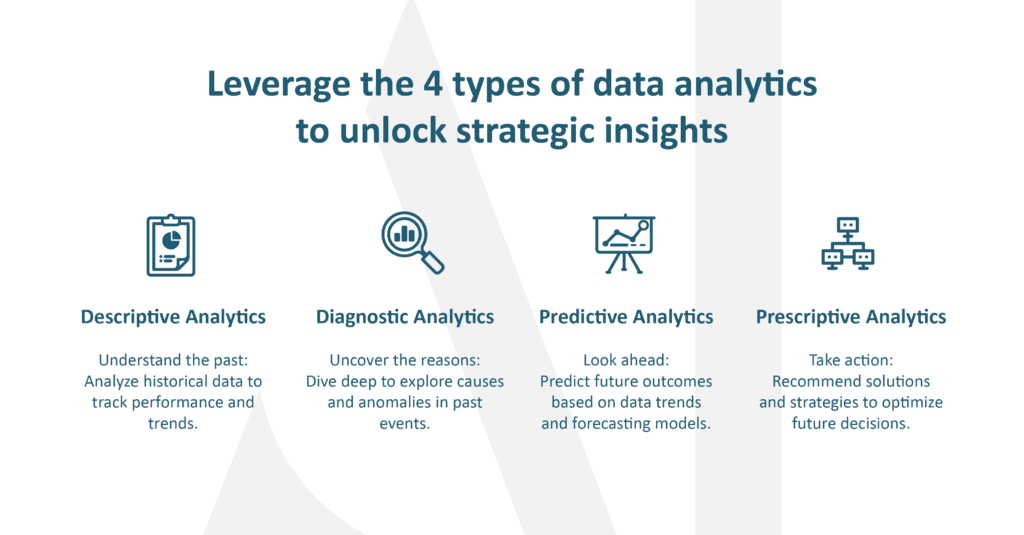
With so many types of data analysis, where do you start? From uncovering past trends to predicting future outcomes and optimizing decisions, understanding the four main types of data analysis – Descriptive, Diagnostic, Predictive, and Prescriptive – can transform raw data into actionable intelligence that aligns with business objectives.
Join us as we explore these distinct types of analysis and discover how each can unlock new opportunities and drive strategic decisions for your business.
What are the 4 Types of Data Analytics?
1. Descriptive Analysis: The foundation of data understanding
Descriptive analysis is often the first step in any data analytics journey. It involves summarizing historical data to identify trends and patterns. This type of analysis answers the question, “What happened?” by providing a comprehensive overview of past events.
Businesses use descriptive analytics to generate reports on key performance indicators (KPIs), such as sales figures or website traffic, providing a snapshot of the current state based on analyzing historical data. Tools like Microsoft Excel, Google Analytics, and Tableau are used to create data visualizations, making it easier to understand and communicate findings.
2. Diagnostic Analysis: Digging deeper into the “why”
While descriptive analytics tells us what happened, diagnostic analysis delves into why it happened. This method involves investigating data to discover causes of past performance, identifying anomalies, and understanding relationships between variables.
Techniques such as hypothesis testing, correlation analysis, statistical modeling, and regression analysis are employed to explore the underlying factors contributing to observed trends. For instance, a company might use diagnostic analytics to determine why a sudden drop in sales occurred, potentially uncovering factors like a competitor’s new product launch or changes in consumer behavior.
3. Predictive Analysis: Forecasting the future
Predictive analysis uses historical data and statistical algorithms to forecast future events. By identifying patterns and trends, predictive analytics provides businesses with valuable insights into potential future outcomes, helping them make informed decisions.
It answers the question, “What might happen?” and is widely used for sales forecasting, risk management, and customer segmentation.
Techniques such as machine learning algorithms and time series analysis are commonly applied. For example, an e-commerce company might use predictive analytics to estimate future sales during a holiday season, allowing for better inventory management and marketing strategies. By employing predictive models, businesses can stay ahead of the curve.
4. Prescriptive Analysis: Recommending actions
Prescriptive analysis goes further by recommending specific actions based on predictive analysis results. It answers the question, “What should we do next?” by suggesting potential solutions to optimize outcomes.
This type of analysis is precious for decision-making, as it forecasts future scenarios and evaluates various strategies to determine the best course of action. Techniques like simulation, optimization algorithms, and decision analysis are incorporated. For instance, ride-hailing companies like Uber use prescriptive analytics to optimize pricing strategies and driver allocation, improving customer satisfaction and operational efficiency.
Why do these analytics matter?
Integrating these four types of data analysis into a cohesive strategy can significantly enhance a company’s decision-making capabilities. By understanding what has happened, why it happened, what might happen, and what should be done, organizations can navigate complex business landscapes more effectively. Businesses can improve profitability, customer acquisition, and operational efficiency by using data analytics. Data-driven firms gain competitive advantage in various key performance metrics, underscoring the importance of a robust analytics strategy.
Understanding these four types of data analysis is essential for any organization aiming to become data driven. Whether you’re just starting your data journey or looking to refine your data strategy, knowing how to apply these types can provide invaluable insights. At DAIN Studios, we specialize in helping companies navigate the complexities of data and AI, ensuring that they harness the full potential of their data assets to make informed decisions.
For more insights and tailored solutions, get in contact with us. Discover how we can help you with your data journey and become data-driven with DAIN, with tailor-made solutions and performance assessments that will drive your potential up. Leverage your data with DAIN!